
Skip to content

Attorney • Bonn, Cologne, Aachen, Koblenz & nationwide

Enforce your rights effectively tailored legal solutions.

As an attorney, I stand by you reliably in all legal matters — both out of court and before the courts. A particular focus of my practice is traffic accident and insurance law.
Exterior view of the law firm, stylised photograph
Attorney Leonard Schneider
Scroll

Your attorney — personal and direct.

Born in Bonn in 1996, I began my law studies at Johannes Gutenberg University Mainz in 2015 and completed them successfully in 2020. During my studies I focused on antitrust and competition law as well as corporate and capital markets law. After the first state examination, I completed my legal clerkship at the Regional Court of Cologne from 2021 to 2023, finishing with the second state examination. In the same year I was admitted to the bar.

From 2023 to 2026 I practised as an attorney in a renowned law firm for traffic and insurance law and represented numerous clients successfully nationwide.

Today I practise as a self-employed attorney in Bonn. In that capacity I advise and represent my clients comprehensively in all areas of law, drawing on sound expertise and extensive experience. What drives me: clear communication, personal commitment, and the goal of finding a tailored solution for every matter.

  • Attorney since 2023
  • Cologne Bar Association
  • Member of the German Bar Association (DAV)
  • Member of the Bonn Bar Association
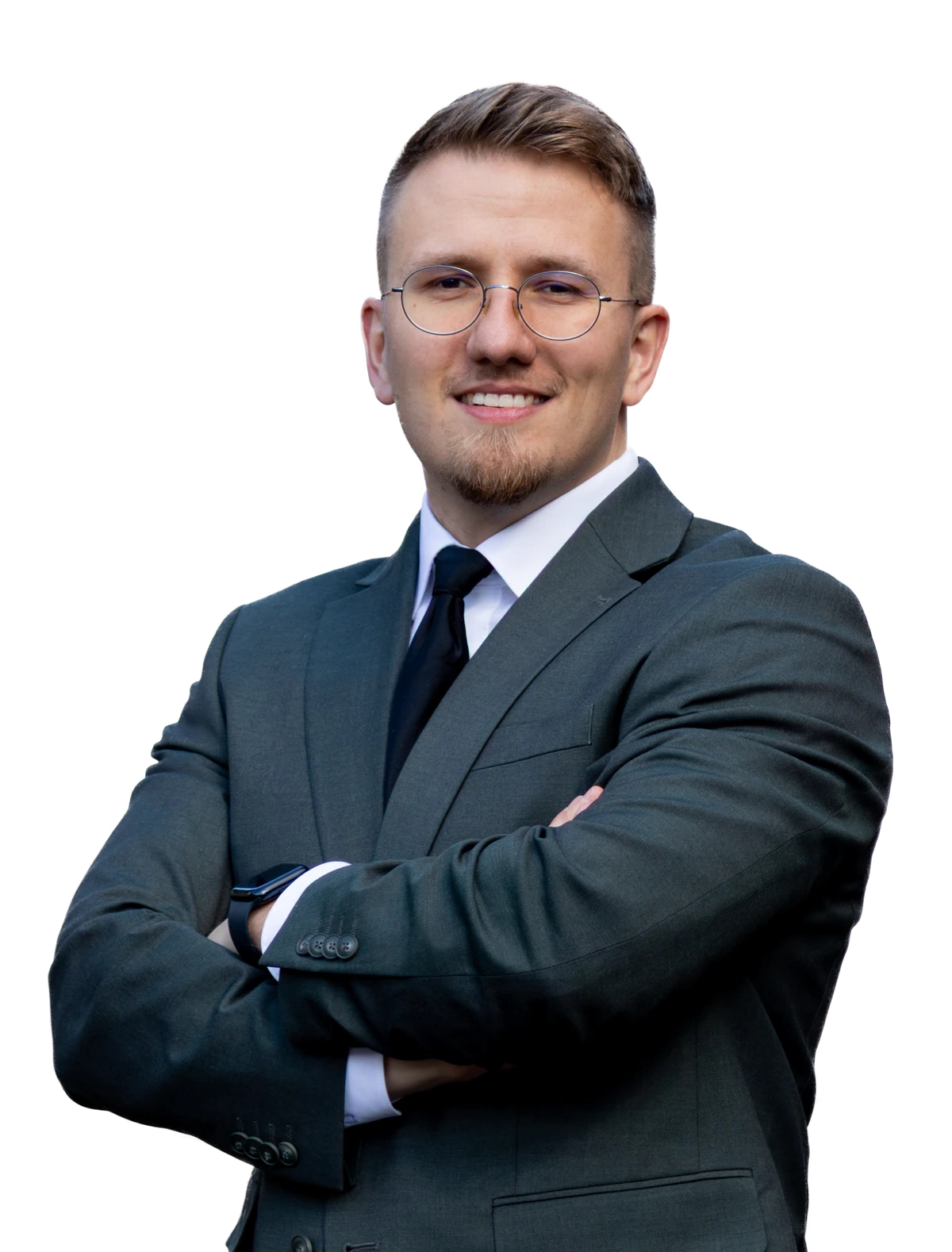
Portrait of attorney Leonard Schneider

A selection of my practice areas.

Road accident

Settlement of motor liability and comprehensive claims — so you are relieved.

Insurance law

Claims under building, home contents and other policies — review and realise.

General civil law

Defence and enforcement of claims of all kinds with a clear strategy.

Personal injury

Loss of earnings, household management damage, medical costs, pain and suffering — determined representation.

Warranty law

Defects under contracts for work and sale — identify them and act with focus.

Traffic fine notice

File an objection, avoid adverse consequences — fast and solution-oriented.

How we work together.

  1. 01

    Get in touch

    Form, email, or phone — you choose.

  2. 02

    Quick response

    Assessment of your situation.

  3. 03

    Clear strategy

    Transparent fees, a concrete roadmap.

  4. 04

    Your outcome

    Committed representation until resolution.

In numbers

400+

clients successfully represented

95 %

digital case handling

3+

years of experience in court practice

24h

average first response time

Frequently asked questions.

What does an attorney cost?
In Germany, attorney fees are governed by the Lawyers’ Fees Act (Rechtsanwaltsvergütungsgesetz, RVG). Fees are generally based on the amount in dispute (Gegenstandswert). Court fees are often added in litigation. Before you instruct me, I will explain the costs in detail — you decide whether to proceed. If the outcome of the case is positive, costs are as a rule to be borne by the other side. If you have legal expenses insurance, the costs are covered from there, except for any excess (Selbstbeteiligung) you may have to pay. If you are not in a position to meet the costs yourself because of your financial situation, you may, where the statutory conditions are met, use Beratungshilfe as well as either Prozess- or Verfahrenskostenhilfe.
Am I entitled to benefits under my insurance policy?
The pivot for claims under an insurance contract is always the applicable policy terms together with the agreed cover. The specific scope of cover follows from the insurance certificate. Both the certificate and the policy terms can look confusing at first glance. I review the full set of terms carefully and determine for your specific case whether a claim exists. If you no longer have the documents to hand, I will request them from the insurer for you — you need not worry about that. Claims against the insurer can also exist in the event of incorrect advice. If you have a claim, I will of course pursue it in a targeted manner.
What should I do immediately after a road accident?
Safety first: secure the scene, use hazard lights, place a warning triangle, call emergency services if people are injured, and provide first aid. Document the accident without delay. Photos of the vehicles as they came to rest can be invaluable later. Photograph all damage at the scene, not only to your vehicle — better one photo too many than too few. Involve the police. The police accident report can matter later. Note witnesses’ contact details. The police often record witnesses too, but a direct phone number or email can speed up contact. Do not admit fault or make unclear statements. Liability is often unclear at the scene; the legal assessment may differ even if you believe you were at fault. Notify your own insurer — even if you were not at fault. Have even apparently minor injuries examined and documented (e.g. whiplash). Involve a traffic law attorney early so that claims for damages or pain and suffering are asserted correctly.
What claims do I have after a traffic accident?
Claims after a traffic accident can be varied and complex. To quantify vehicle damage, a professional damage report is usually required first. If you have not yet obtained one, I will gladly help you find a suitable expert. In non-fault accidents, the other party or their motor liability insurer bears the cost of the report. Caution: for very minor damage, commissioning a full expert report may not be appropriate and costs may not be covered. You should involve a traffic attorney as early as possible to avoid mistakes during the initial claims process. From the outset I will work through all options with you to pursue the damage in line with your preferences — for example, whether to claim on a fictitious basis (i.e. claim the necessary costs without repairing the vehicle) or to assert a specific claim after repair.
Will my legal expenses insurance cover the costs?
Legal expenses insurance often covers both in-court and out-of-court costs — meaning no financial risk for you and full support in the process. Whether your specific matter is covered depends on the scope of cover in your policy. Not every case is automatically insured; small details can matter. I handle all communication with your insurer to avoid misunderstandings and delays. Some policies include an excess that you must pay; in a successful outcome that share is often recoverable from the other side. The so-called quota privilege (Quotenvorrecht) can also mean that your excess is repaid in full even after a partial success.
How does the first contact work?
The first contact is simple and straightforward. You get in touch via the contact form on the website, by email, or by phone. Please describe your matter as fully as possible and leave your contact details. The contact form and contact by email are useful because documents can be sent that way. The more information you give me, the better I can assess your matter legally. Important: the first contact does not create a client relationship. After a brief review of your matter I will get back to you promptly to arrange a conversation. In a first meeting we discuss your case and consider next steps. I will also explain costs transparently. Only after that do you decide whether to instruct me.
Is it worth appealing a traffic fine?
As a rule, appealing a traffic fine is almost always worthwhile. Many notices contain formal or substantive errors that can lead to a reduced fine or the notice being set aside entirely. To review your notice reliably, it is mandatory to inspect the official investigation file. I will file the corresponding application for file inspection. The prospects of success can then be assessed and the objection reasoned. In uncertain cases — borderline cases — it can make sense to check before filing the objection whether costs are covered by legal expenses insurance. That limits financial risk if the objection fails. It is important to act quickly after receiving a fine and to observe the appeal deadline. It is two weeks from service of the notice. If you miss the deadline, the fine becomes final and a later objection is only possible in very narrow circumstances. To avoid missing deadlines, it is advisable to involve an attorney promptly.
How long do I have to assert claims?
Most claims are subject to limitation: they cannot be asserted indefinitely. The standard limitation period in Germany is three years, starting at the end of the year in which the claim arose and the creditor obtained knowledge of the circumstances giving rise to the claim and of the debtor’s identity. Certain claims follow special rules — for example two years for defects under purchase contracts or five years for claims related to buildings. For particularly serious claims, such as damages for injury to life, limb, or health, the period can be up to thirty years. Under certain conditions limitation can be suspended or interrupted. Interruption may occur, for example, if the debtor acknowledges the debt or court measures are taken to enforce the claim. To determine whether a claim is still enforceable and to secure a claim before it becomes time-barred, involving an attorney is advisable.

Write to me.

You may attach files (e.g. PDF, images). They may contain personal data and are processed only to handle your inquiry; see the privacy policy for details. Up to 10 MB per file.

Address

Agnesstraße 19
53225 Bonn

Office hours

Telephone hours: Mon–Fri, 2:00 p.m.–5:00 p.m. Appointments by arrangement